
 English
 Español
 Português
 Français
 اللغة العربية
 Русский язык

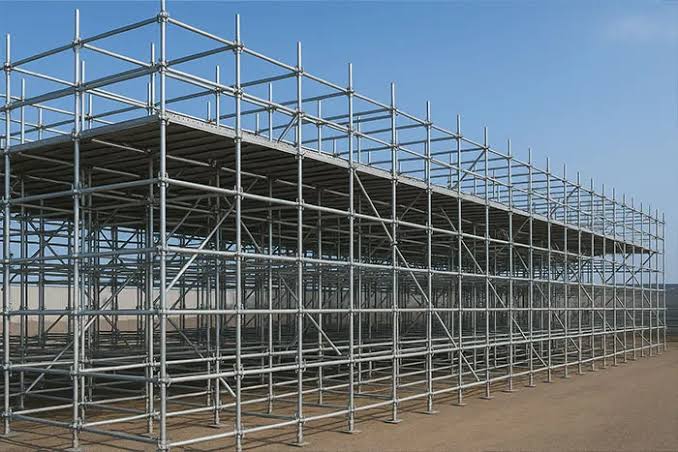
country: saudi arabia, eastern province industrial zone
the challenge: fixed shutdown windows and moving work fronts
refinery turnarounds in the middle east compress inspection, welding, heat-exchanger bundle pulling, valve replacement and ndt into a shutdown window measured in weeks. piping is dense, exchanger shells sit close together, and the work front moves as each maintenance scope is opened and closed. a scaffolding system that is slow to strike or rebuild does not only consume labour; it takes critical-path hours away from welding and inspection.
the scaffold also has to carry concentrated loads from bundle-extraction platforms and valve-change decks while surviving ambient temperatures above 50°c, coastal salt-laden air and trace h2s in the process atmosphere. in the jubail and yanbu industrial zones, cuplock is already a established heavy-duty shoring system for petrochemical and refinery work. the challenge is not whether to use it, but how to configure, verify and mobilise it against a shutdown clock that does not forgive improvisation.
the solution: lock geometry that matches how turnarounds actually move
the project deployed a cuplock system in which the connection geometry is defined at the cup, not at the factory. each vertical standard carries a forged bottom cup at 0.5 m intervals; each ledger carries forged blade ends. dropping the ledger blade into the bottom cup and sliding the top cup down locks up to four ledgers at the same time with a single hammer strike. for turnaround work, this produces three operational advantages.
first, the scaffold moves at the speed of the work front. a bay can be struck and re-erected in a new location without loosening a single bolt or losing a component. on a four-week turnaround window, reduced erection and dismantling hours translate directly into recovered welding and inspection time.
second, the node carries load without relying on friction alone. forged top cups and blades are positively engaged by gravity and wedge action, so the joint maintains clamping integrity under vibration and static load. the standard configuration of 48.3 mm od, 3.2 mm wall and s355 grade supports working platforms for exchanger bundle extraction and valve replacement, where a single leg may see loads well above general-access duty. this is why cuplock is specified for refinery and petrochemical shoring rather than general-purpose access.
third, the scaffold wraps around existing facilities. ledger lengths are pre-cut to work-front dimensions, and the cup-and-blade connection tolerates the small angular deviations that occur when standards are founded on uneven concrete, steel grating or temporary mats. in exchanger rows, the frame can be built as an asymmetrical support with one face close to the shell and the other set back for access. in pipe-rack corridors, bay width is adjusted by ledger selection rather than by cutting tubes on site, preserving the galvanized coating and removing a corrosion initiation point.
quality control and export execution
every standard and ledger batch was verified before shipment. standard inspection covered outer diameter tolerance, wall thickness, straightness and hot-dip galvanized coating thickness, with a mean of at least 85 μm and spot checks at cup and blade weld zones where coating uniformity is most vulnerable. cup-and-blade assemblies were checked for forging soundness, dimensional fit and locking engagement. sample assemblies were load-tested to confirm that clamp hold exceeded the 3 kn threshold under repeated lock-release cycles. steel grade certificates were traced to heat number, and each bundle carried a batch identifier linked to the inspection record.
for export to the kingdom, components were packed in steel-banded bundles by work-front sequence rather than by component type alone, so that the first bays required on site were the first bundles off the truck. material certificates, third-party inspection reports and packing lists were aligned with the client's shutdown mobilisation schedule. on a turnaround, a missing bundle of 2.0 m ledgers can idle a crew that has already been badged, trained and lifted to the work front.
future direction
cuplock will remain the default heavy-duty access system for middle east refinery turnarounds as long as shutdown intervals shorten and the proportion of planned-to-unplanned work continues to rise. the next phase of supply is not about changing the lock geometry. it is about matching the